At its heart, the 482 visa process is a three-way partnership. First, an employer must be approved as a sponsor. Second, they need to nominate a specific skilled role they can't fill locally. Finally, you, the applicant, must meet the specific health, character, and skill requirements for that nominated job.
The 482 visa is a temporary pathway that lets skilled professionals work in Australia for up to four years, filling critical labour shortages and, for many, opening up potential pathways to permanent residency down the track.
Disclaimer: Australian migration laws and policies are subject to change. The information provided in this article is for general guidance only and may not be current at the time of reading. For the most accurate and up-to-date advice tailored to your specific situation, we strongly recommend booking a consultation with a registered migration agent. All official government fees should be confirmed on the Department of Home Affairs website.
What Is The 482 TSS Visa In Australia?
The Temporary Skill Shortage (TSS) visa, officially known as Subclass 482, is a real workhorse of Australia's skilled migration program. Think of it as a vital bridge connecting talented international professionals with Australian businesses that are genuinely struggling to find the right people locally. It’s not just another work permit; it’s a targeted solution designed to address very specific gaps in our economy.

The whole system is built around employer sponsorship. This is key. You can't just apply for this visa on your own. A business has to identify a need, find you, and agree to nominate you for the position.
The Three Pathways Of The 482 Visa
To handle different needs across the economy, the 482 visa is split into three distinct streams. Each one has its own rules, occupation lists, and potential outcomes, so figuring out which one applies to you is the very first step.
- Short-Term Stream: This is for employers needing to bring in skilled workers for roles on the Short-term Skilled Occupation List (STSOL). As the name suggests, it’s a more temporary fix, usually granting a visa for up to two years.
- Medium-Term Stream: This one is aimed at filling more critical, longer-term skills gaps. It's for occupations on the Medium and Long-term Strategic Skills List (MLTSSL) and offers a visa for up to four years, plus a clear pathway to permanent residency for eligible holders.
- Labour Agreement Stream: This is a more bespoke arrangement. It’s for employers who have negotiated a special agreement directly with the Australian government because their labour needs are unique and aren't covered by the standard streams.
Important Disclaimer: Australian migration law is complex and changes often. The information here is for general guidance and might not be current when you read it. It's crucial to get professional advice that's tailored to your exact situation.
Who Is This Visa For?
The Subclass 482 visa is a two-way street. It’s for skilled professionals looking to build their careers in Australia, and it's for Australian businesses that need to fill essential roles to keep operating and growing.
For you, the applicant, it’s a chance to gain valuable Australian work experience and, in many cases, start a journey towards making Australia your permanent home. For employers, it’s a lifeline that provides access to a global talent pool.
To make sure you're working with the most up-to-date information, we strongly recommend booking a consultation with a MARA-registered migration agent at My Visa Guide. For the latest official government fees and charges, always check the Department of Home Affairs website directly.
Picking the Right 482 Visa Stream for You
Not all Subclass 482 visas are created equal. The very first fork in the road on your application journey is figuring out which of the three distinct pathways, or "streams," is the right fit for your job and your long-term plans in Australia. Getting this right from the get-go is absolutely crucial, because each stream has its own rulebook, visa length, and, most importantly, different potential for permanent residency.
Here’s a simple way to think about it. The Short-Term stream is a bit like a fixed-term contract—it’s built to fill immediate, temporary gaps in the Aussie workforce. The Medium-Term stream, on the other hand, is more like a permanent role with a clear career path, designed for jobs that are considered vital to Australia’s long-term economic health. And then there's the Labour Agreement stream, which is a totally custom-built solution for industries with unique skill needs that don’t quite fit into the other two boxes.
Getting your head around these differences is key to setting realistic expectations and mapping out your future down under. Let’s dive into what sets them apart.
Short-Term Stream: Your Foot in the Door
The Short-Term stream is for anyone whose occupation is on the Short-term Skilled Occupation List (STSOL). These are jobs that Aussie businesses need to fill right now, but they aren't necessarily seen as being in critical, long-term shortage.
This stream typically gets you a visa for up to two years. While it's a fantastic way to get your foot in the door and gain valuable Australian work experience, its path to permanent residency used to be quite limited. The good news is that recent changes have opened this up, making it a much more viable long-term option than it once was.
Medium-Term Stream: The Clear Path to Permanency
If your occupation is listed on the Medium and Long-term Strategic Skills List (MLTSSL), you’re looking at the Medium-Term stream. This is the pathway for skilled professionals in roles that are pretty much always in high demand across Australia.
This stream gives you a much longer leash, with a visa for up to four years. The biggest drawcard, though, is that it offers a direct and well-trodden path to permanent residency, usually through the Subclass 186 visa after you’ve worked for your employer for a couple of years. For many people, this is the golden ticket because of the stability and long-term settlement options it provides.
Labour Agreement Stream: A Custom-Fit Solution
The Labour Agreement stream is the most specialised of the bunch. It works completely outside the standard occupation lists and is based on a formal deal negotiated between a specific employer (or a whole industry) and the Australian Government.
These agreements are put in place to tackle very specific skill shortages in sectors like aged care or agriculture, where the standard visa programs just don't cut it. Everything—from the visa duration and conditions to the pathway to permanent residency—is defined within the agreement itself, making it a highly tailored and unique option.
A Quick Word on Visa Conditions: No matter which stream you're on, all 482 visa holders must work only for their sponsoring employer in their nominated occupation. If you breach these conditions, you could be in serious trouble and risk losing your visa.
To make things even clearer, the table below breaks down the key differences at a glance. It's a quick and easy way for you and your employer to see which pathway lines up best with your situation and career goals.
Comparing The 482 Visa Streams At A Glance
| Feature | Short-Term Stream | Medium-Term Stream | Labour Agreement Stream |
|---|---|---|---|
| Eligible Occupations | Roles on the Short-term Skilled Occupation List (STSOL) | Roles on the Medium and Long-term Strategic Skills List (MLTSSL) | Occupations specified in the individual labour agreement |
| Maximum Visa Stay | Up to 2 years (or 4 years under international trade obligations) | Up to 4 years | As specified in the agreement, often up to 4 years |
| Permanent Residency | Pathway available, often requiring a longer period of work | Direct pathway to PR, typically after 2 years of work | Pathway to PR is defined within the terms of the agreement |
| English Requirement | Must meet the minimum English language requirements | Must meet the minimum English language requirements | Requirements are set out in the specific agreement |
As you can see, the stream you choose has a massive impact on your entire visa experience. It dictates how long you can stay, what your future options look like, and the specific rules you’ll need to follow.
Disclaimer: Visa requirements and government policies are subject to change. The information provided in this article is for general guidance only and may not be current at the time of reading. For the most accurate and up-to-date advice tailored to your specific situation, we strongly recommend booking a consultation with a registered migration agent. All official government fees should be confirmed on the Department of Home Affairs website.
Meeting The Eligibility Criteria For Applicants
Think of a Subclass 482 visa application as a two-part story. Your employer tells one half—why they need you—and you tell the other. Your part is all about proving you've got the skills, experience, and personal background to not only do the job but also to be a positive addition to the Australian community. Ticking these boxes isn't just a formality; it's non-negotiable.

You're essentially building a case for the Department of Home Affairs. Every document and piece of evidence you provide adds another layer of credibility, painting a clear picture of who you are. Let's break down exactly what you need to bring to the table.
Proving Your Skills And Work Experience
The absolute cornerstone of your application is demonstrating you have genuine, hands-on experience in your nominated occupation. This is where you show the Department that you can walk the walk.
As a general rule, you’ll need to prove you have at least two years of relevant, full-time work experience (or the part-time equivalent). Crucially, this experience should be recent—ideally from the last five years—to show your skills are up-to-date with current industry standards.
This is where you need to go beyond a simple CV. You'll need to dig up solid proof, including:
- Detailed Employment Reference Letters: These must be on official company letterhead, clearly stating your role, specific duties, employment dates, and salary.
- Pay Slips or Bank Statements: This is the hard financial evidence that backs up your employment history.
- Employment Contracts: Formal contracts are great for verifying the terms and conditions of your past roles.
- Skills Assessments: Depending on your occupation, you might need a formal skills assessment from a designated authority. This is an independent body that will validate your qualifications and experience against Australian standards.
Meeting The English Language Requirements
Unless you qualify for an exemption, you’ll need to prove your English language proficiency. This isn't just about passing a test; it’s about showing you can communicate clearly and safely in your new workplace and community.
The Department accepts scores from several approved tests, and the goalposts can shift slightly between visa streams. A common benchmark, however, is an overall IELTS score of 5.0, with no single band score falling below 4.5 (or the equivalent score in other tests like PTE Academic or TOEFL iBT).
Important Update: The validity period for English test results has been extended. They are now generally valid for three years prior to your visa application lodgement, which gives you a bit more breathing room. Always double-check the latest legislative instruments for the exact scores you need.
You might be exempt from testing if you hold a passport from the UK, USA, Canada, New Zealand, or Ireland, or if you've completed at least five years of full-time study where all classes were conducted in English.
Passing The Health And Character Checks
Finally, every person on the visa application—that includes you and any family members—must meet Australia’s strict health and character requirements. These are in place to protect the Australian community.
The health requirement involves a medical examination with a government-approved panel physician. They're checking to make sure you don’t have a health condition that could be a public health risk or place a major burden on Australia’s healthcare system.
For the character check, you'll need to provide police certificates from every country you’ve lived in for 12 months or more over the last 10 years (since you turned 16). The Department uses this to assess your background and ensure you're of good character. To get a complete picture of what’s involved, have a look at our detailed guide on Australian visa health and character requirements. Getting this part right is absolutely critical for a successful outcome.
Disclaimer: Visa requirements and government policies are subject to change. The information provided in this article is for general guidance only and may not be current at the time of reading. For the most accurate and up-to-date advice tailored to your specific situation, we strongly recommend booking a consultation with a registered migration agent. All official government fees should be confirmed on the Department of Home Affairs website.
Understanding The Employer’s Side of the Equation
A successful 482 visa isn’t a one-way street; it’s a genuine partnership between you and your Australian employer. While you’re busy proving your skills and background, your employer has a hefty list of their own legal and financial responsibilities to meet. For any business wanting to hire from overseas, this means becoming a Standard Business Sponsor (SBS), which is a formal approval from the government that shows they’re committed to playing by Australia’s migration rules.
This sponsorship status is more than just a certificate on the wall. It’s a serious pledge to be a responsible employer for international workers. The business has to show it’s operating legally, is in good financial standing, and has a solid history of employing local Aussies. Getting a handle on these obligations is the first, crucial step for any company looking to bring in global talent. You can dive deeper into this process in our full guide to becoming an employer sponsor.
Proving The Job Is Real
One of the biggest hurdles for an employer is proving the job they’re offering is a genuine, full-time role that the business actually needs. The Department of Home Affairs looks at this very closely to make sure the visa program isn't being misused to create phantom jobs or to simply bypass the local job market.
To prove the position is legit, a business usually needs to provide things like:
- A detailed organisational chart showing exactly where the new role fits in.
- A comprehensive position description that clearly spells out the day-to-day duties.
- Hard evidence showing how this specific role will help the business operate and grow.
Think of it as a safeguard. It ensures that every sponsored job is there to fill a real, documented skill shortage in the Australian economy.
Testing The Local Job Market First
Before an employer can even think about nominating an overseas worker, they have to prove they’ve tried to find an Australian to do the job first. This is a mandatory process called Labour Market Testing (LMT), and it’s non-negotiable.
The rules around LMT are strict. The employer must advertise the position for at least 28 days within the four months just before they lodge the nomination. The ads can’t just be anywhere, either—they must be on at least two approved national platforms, like the government's Workforce Australia site plus a major online job board like SEEK.
This isn't just a box-ticking exercise. The employer has to submit copies of the ads and a summary of the applications they received, complete with a solid explanation for why any local candidates weren't the right fit.
Paying The Right Salary
To protect overseas workers from being underpaid and to keep local wages from being driven down, employers have to pay the sponsored worker a fair wage. The salary must be at or above the Annual Market Salary Rate (AMSR), which is basically what an Australian worker would be paid for the same job in the same city.
On top of that, the offered salary must also be equal to or higher than the Temporary Skilled Migration Income Threshold (TSMIT). This is a minimum salary benchmark set by the government, which is currently $70,000 per year plus superannuation. This two-part test ensures the pay is competitive and aligns with both market standards and government policy.
The Skilling Australians Fund Levy
There’s also a significant financial commitment called the Skilling Australians Fund (SAF) levy. This is a payment the employer has to make when they lodge the nomination. The money collected goes directly into a fund that supports training and apprenticeships for Australian workers. The amount they pay depends on the business's size and how long your visa will be.
- For small businesses (annual turnover under $10 million), the levy is $1,200 for each year of the visa.
- For larger businesses (annual turnover of $10 million or more), it’s $1,800 per year.
This levy reinforces a core principle of the program: hiring from overseas should also directly benefit and help upskill the local workforce.
The demand for skilled workers across Australia is incredibly high. By 31 March 2025, a massive 63,700 primary applications had been lodged, a 53% jump from the same time in the previous year. New South Wales is leading the charge with 36% of applications, followed by Victoria at 22% and Western Australia at 18%, especially in high-paying industries like mining and finance.
When it comes to getting the paperwork in order, many modern businesses are looking for efficiencies. Understanding how to properly handle e-signatures for employment contracts can be a big help in making sure all the employment documentation is both compliant and secure.
Disclaimer: Visa requirements and government policies are subject to change. The information provided in this article is for general guidance only and may not be current at the time of reading. For the most accurate and up-to-date advice tailored to your specific situation, we strongly recommend booking a consultation with a registered migration agent. All official government fees should be confirmed on the Department of Home Affairs website.
The Three-Act Play of a 482 Visa Application
Applying for a 482 visa isn't a single event; it's more like a three-act play. Each stage—Sponsorship, Nomination, and the final Visa Application—has its own role, and they all need to come together perfectly for a successful outcome.
Understanding this sequence is key. It helps everyone, both the business and the applicant, know what’s coming next and where to focus their efforts. Think of it as a roadmap where each turn is clearly marked, ensuring you don’t miss a critical step on the journey.
Act 1: The Sponsorship Application
The first move is entirely up to the employer. Before a business can even think about nominating you, it must first become an approved Standard Business Sponsor (SBS). This is where the company applies to the Department of Home Affairs to prove it's a legitimate, financially sound business operating lawfully in Australia.
This stage is the foundation for everything that follows. Once the business gets the green light, its SBS status is usually valid for five years. This is a huge plus, as it means they can sponsor multiple skilled workers during that time without having to go through this whole process again for each person.
Act 2: The Nomination Application
With the SBS approval in the bag, the employer can now nominate a specific role they need to fill with an overseas worker. This is where the job itself gets put under the microscope.
The business has to provide solid evidence on a few critical points:
- It's a Genuine Position: They need to demonstrate that the job is real and necessary for the business's operations.
- They've Tried Hiring Locally: This is called Labour Market Testing (LMT). The business must show it advertised the role in Australia and genuinely couldn't find a suitable Australian citizen or permanent resident to do the job.
- The Pay is Fair: The salary on offer has to meet the market salary rate, meaning it's in line with what an Australian would be paid for the same work in the same location.
At this stage, the employer also pays the Skilling Australians Fund (SAF) levy, a mandatory government fee.
Act 3: The Visa Application
Now, it's your turn to take the stage. As soon as the nomination is lodged, you can submit your visa application. This is where you provide all the documents to prove you meet the specific criteria for the 482 visa.
This means showing evidence of your qualifications, work experience, English language skills, and, of course, passing the standard health and character checks. The goal is to lodge a "decision-ready" application—one that's complete, well-organised, and has all the required evidence, so an immigration officer can make a quick and positive decision.
A Note on Timing: While these are three distinct stages, you don't always have to do them one after the other. The Nomination and Visa applications can often be lodged at the same time, which can really speed up the overall process.
So, How Long Does It All Take?
This is the million-dollar question. Processing times for the 482 visa can vary wildly depending on things like how complete your application is, whether your employer is an accredited sponsor, and even what your nominated occupation is.
A well-prepared, decision-ready application will always be at the front of the queue. While official government targets aim for a 21-day turnaround for the Core Skills Stream, real-world averages often fall somewhere between 21-47 days. However, for occupations in high demand, things can move much faster. We've seen applications for priority roles get approved in as little as 5-10 days. For example, a complete application for a Registered Nurse could sail through in just a week. You can find more insights on 482 visa sponsorship trends at expatnetwork.com.
Disclaimer: Visa requirements and government policies are subject to change. The information provided in this article is for general guidance only and may not be current at the time of reading. For the most accurate and up-to-date advice tailored to your specific situation, we strongly recommend booking a consultation with a registered migration agent. All official government fees should be confirmed on the Department of Home Affairs website.
Your Pathway From 482 Visa To Permanent Residency
For many skilled professionals, the Subclass 482 visa isn't just a temporary work pass—it's the first real step towards building a life in Australia. Think of it as a well-trodden springboard to permanent residency (PR), most often through the Employer Nomination Scheme (Subclass 186) visa. With a bit of forward planning, your temporary stay can absolutely transform into a permanent future.
The most common route by far is the Temporary Residence Transition (TRT) stream of the 186 visa. This pathway was specifically created for 482 visa holders who've been with their sponsoring employer for a while and are ready to put down permanent roots.
Key Milestones on the Path to PR
Making the leap from a 482 visa to PR means hitting a few specific milestones. The good news is the government has recently made this journey a lot more straightforward by shortening the required employment period.
Under the current rules, you generally need to have worked for your sponsoring employer, full-time, for at least two years while holding your 482 visa. This is a game-changer, as it's significantly cut down the waiting time and fast-tracked the path to permanency for countless applicants.
Crucial Insight: Staying fully compliant with your 482 visa conditions during these two years is non-negotiable. Any slip-ups, like working for a different employer without authorisation, can seriously jeopardise your future PR application.
The whole journey starts with successfully getting your 482 visa in the first place, which is a three-step process in itself.
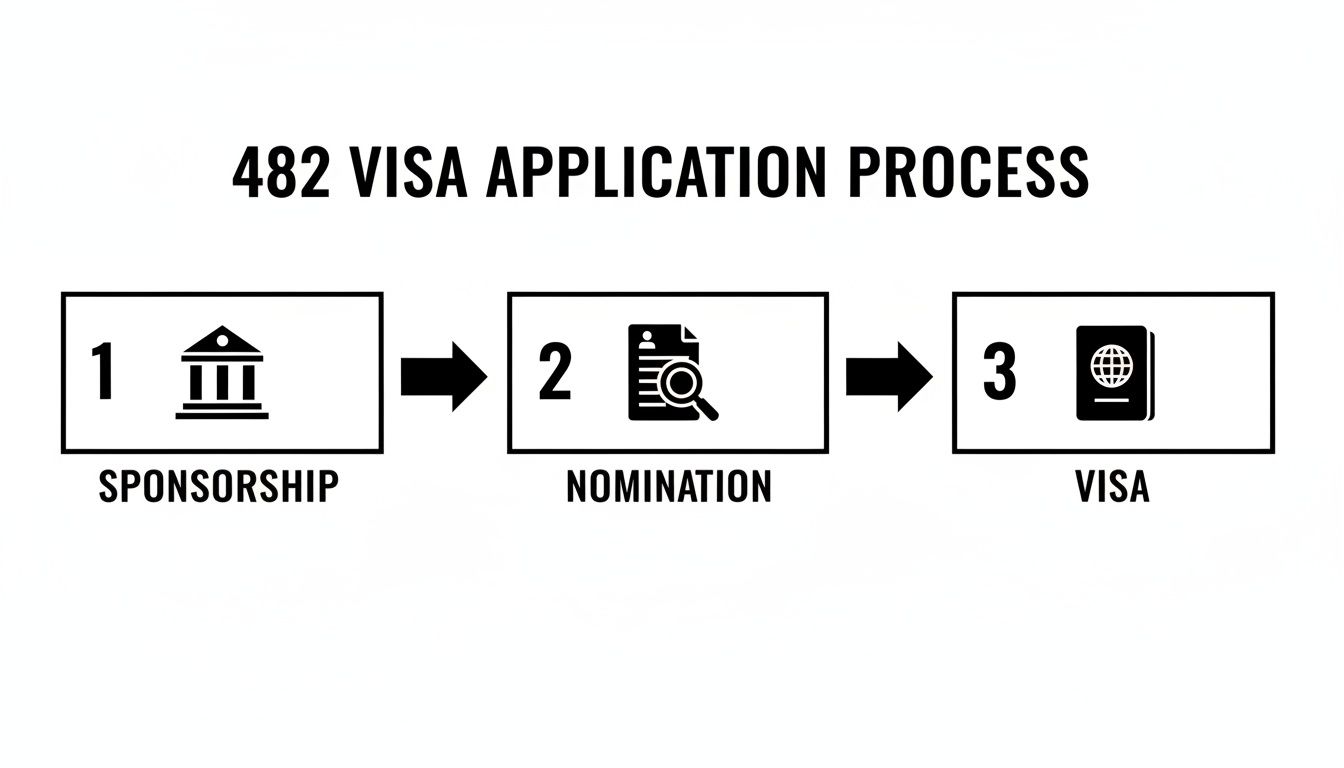
As you can see, you need to navigate the Sponsorship, Nomination, and Visa stages before you can even begin counting down your time towards PR.
Eligibility Criteria for the 186 TRT Stream
Once you've clocked your two years of work, there are still a few other boxes you and your employer need to tick for a successful 186 TRT application. These include:
- Continued Employer Support: Your employer must still be on board and willing to nominate you for the permanent role.
- Age Requirement: You generally need to be under 45 years old when you apply, although some exemptions do exist.
- Health and Character: You, and any family members included in the application, must continue to meet Australia's standard health and character checks.
This pathway really highlights how much Australia values the contribution of its skilled temporary residents. In the 2024-25 program year alone, 32,130 skilled temporary visa holders—many on the 482—made the switch to a permanent or provisional visa. This follows a strong trend, building on the 52,100 grants in 2023-24 and 51,610 in 2022-23, proving that the 482 visa is a primary feeder for Australia's permanent skilled migration program.
It's always a good idea to get familiar with all the options available. You can dive deeper into the various routes in our complete guide to employer-sponsored visa pathways.
Disclaimer: Visa requirements and government policies are subject to change. The information provided in this article is for general guidance only and may not be current at the time of reading. For the most accurate and up-to-date advice tailored to your specific situation, we strongly recommend booking a consultation with a registered migration agent. All official government fees should be confirmed on the Department of Home Affairs website.
Common Questions About The 482 Visa
Working through the 482 visa requirements always brings up a few practical, real-world questions. To clear up some of the most common points of confusion for both applicants and their sponsoring employers, here are some straight answers to the questions we hear most often.
Can My Family Join Me On A 482 Visa?
Yes, absolutely. You can include members of your immediate family unit in your Subclass 482 visa application, which typically covers your partner and any dependent children.
It's crucial to list every family member on the application form, even if they aren't planning to migrate with you. Just remember, every family member you include will also need to meet Australia’s standard health and character requirements to keep the process running smoothly for everyone.
What If I Lose My Job On A 482 Visa?
Losing your job while on a 482 visa is definitely stressful, but there’s a clear process in place. If your sponsored employment comes to an end, your visa isn't cancelled on the spot. You're generally given 60 consecutive days to sort things out.
During that time, you have three options:
- Find another approved employer to take over your sponsorship.
- Apply for and be granted a different type of Australian visa.
- Make arrangements to leave Australia.
It’s a non-negotiable condition of your visa that you inform the Department of Home Affairs as soon as your employment ends.
Financial Considerations for Visa Holders
If you're on a 482 visa and thinking about buying or selling property in Australia, it's really important to get your head around the specific financial rules that might apply to you. This includes things like the foreign resident capital gains withholding rules. Understanding these obligations is key to managing your finances properly while you're here.
What Are The Most Common Refusal Reasons?
Visa refusals are heartbreaking, and most of them are avoidable with careful preparation. One of the biggest tripwires is the employer failing to meet the very strict Labour Market Testing (LMT) requirements. Another common issue is an applicant simply not providing enough solid evidence to prove their skills and work experience.
Other frequent problems include the Department not believing the nominated role is genuine, or an applicant failing the mandatory health and character checks. A meticulously prepared application is your best defence against these risks.
Disclaimer: Visa requirements and government policies are subject to change. The information provided in this article is for general guidance only and may not be current at the time of reading. For the most accurate and up-to-date advice tailored to your specific situation, we strongly recommend booking a consultation with a registered migration agent. All official government fees should be confirmed on the Department of Home Affairs website.
Getting the 482 visa across the line demands real expertise and a sharp eye for detail. My Visa Guide offers professional, MARA-certified guidance to ensure your application is rock-solid and fully compliant, seriously boosting your chances of a successful outcome. Book your consultation at https://www.myvisaguide.com.au to start your journey with confidence.