When you're looking at the subclass 482 visa, one of the biggest hurdles for many is proving your English skills. This isn't just a box-ticking exercise; the Department of Home Affairs needs to know you can communicate effectively and safely in an Australian workplace. It’s a crucial step that unlocks both your professional life and your ability to settle into the community here.
Disclaimer: Australian immigration law is complex and subject to frequent changes. The information provided in this article is for general guidance only and may not be current at the time of reading. For the most accurate and up-to-date advice tailored to your specific situation, it is essential to book an appointment with a registered migration agent. Please refer to the official Department of Home Affairs website at https://www.homeaffairs.gov.au/ for any visa-related government fees.
Why English Skills Are a Must for the 482 Visa
Navigating the Temporary Skill Shortage (TSS) visa, or subclass 482, means meeting several key criteria, and your English ability is right at the top of the list. Think of it as the foundational tool in your kit for building a new life in Australia.
The government's logic is simple: without a solid grasp of English, understanding important workplace instructions or following safety standards becomes a real challenge. It affects everything from your job performance to day-to-day conversations.
Understanding the Different Visa Streams
The 482 visa isn't a one-size-fits-all deal. It's broken down into three different streams, and the English requirements can vary depending on which one you're applying for.
- Short-Term stream: This is for occupations on the short-term skilled occupation list.
- Medium-Term stream: This stream covers occupations on the medium and long-term strategic skills list and, importantly, can offer a pathway to permanent residency down the track.
- Labour Agreement stream: This is a special category for employers who have negotiated a direct agreement with the Australian government to bring in skilled workers.
While the Short-Term and Medium-Term streams have pretty standard English language benchmarks, the Labour Agreement stream can have its own unique rules. Figuring out which stream you fall under is the absolute first step to knowing what English score you need to aim for.
Important Disclaimer
Australian immigration law is always changing. The information here is a general guide and might not be up-to-date when you read it. For advice that’s tailored to your specific situation, you really must book an appointment with a registered migration agent. All official government fees are listed on the Department of Home Affairs website. Please refer to https://www.homeaffairs.gov.au/ for any department fees for any visa.
If you happen to be a Spanish speaker looking to sharpen your skills, a guide with practical English lessons could be a really helpful resource.
Navigating the Accepted English Tests and Scores
Trying to figure out the exact English test scores you need for your 482 visa can feel a bit like decoding a secret message. The Australian government gives the nod to several reputable test providers, but here's the catch: a strong overall score isn't enough. You have to hit the minimum mark for each individual skill—listening, reading, writing, and speaking.
Each test is a different beast. The International English Language Testing System (IELTS) uses a band system, while the Pearson Test of English (PTE) Academic is all about points. This means you can't just swap scores between them. Choosing the right test often comes down to playing to your personal strengths.
Your Visa Stream Determines Your Score
The level of English you need to prove is tied directly to which 482 visa stream you're applying for. For the Short-Term and Medium-Term streams, the rules are pretty set. But for the Labour Agreement stream, the requirements can be tailored to that specific agreement.
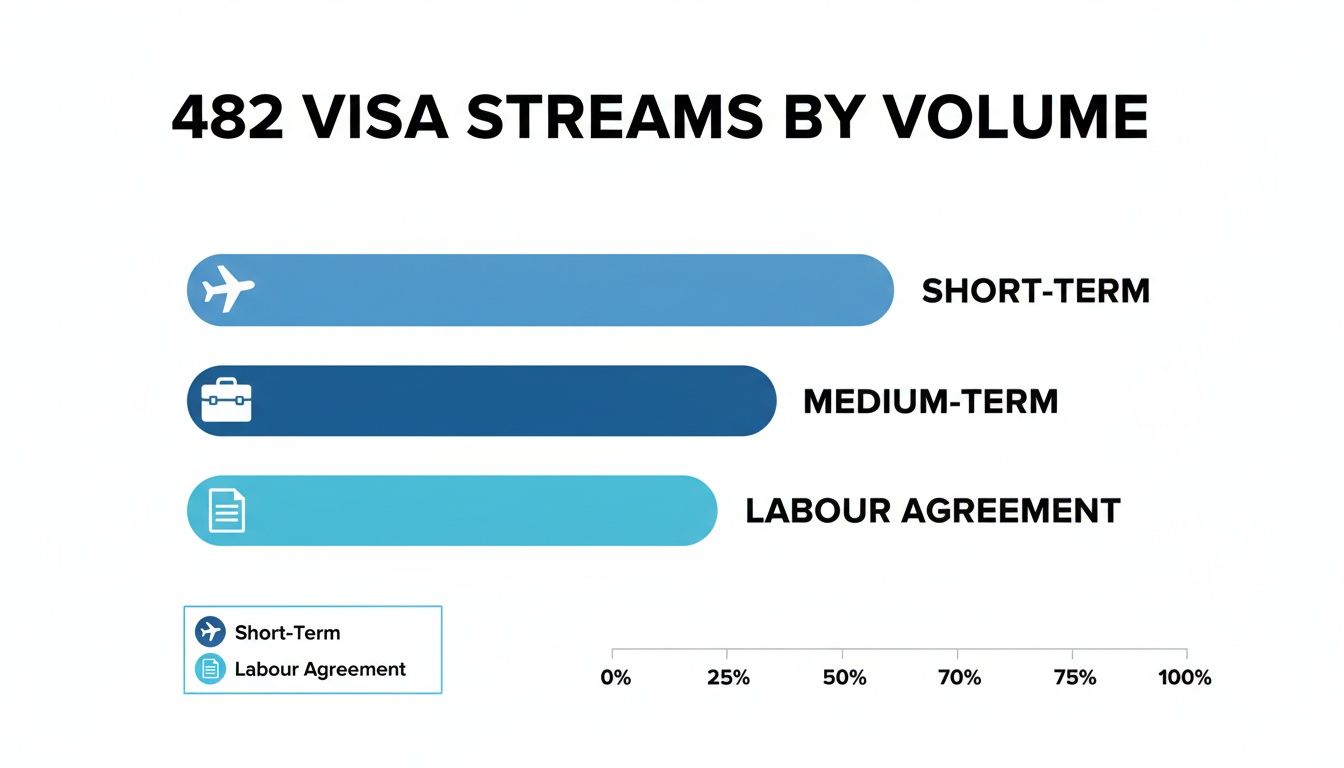
As you can see, each stream is designed for a different purpose in Australia's skilled migration program. The job you've been offered will be the main factor in deciding which stream is right for you.
Minimum English Test Scores for Subclass 482 Visa (Short-Term & Medium-Term Streams)
To tick the box for the 482 visa English requirements, you must hit the minimum score in every single component of your chosen test, and you have to do it all in one sitting.
Here’s a straightforward breakdown of the scores you’ll need to aim for across the most common tests.
| Test Provider | Listening | Reading | Writing | Speaking | Overall Score |
|---|---|---|---|---|---|
| IELTS | 5.0 | 5.0 | 5.0 | 5.0 | 5.0 |
| PTE Academic | 36 | 36 | 36 | 36 | 36 |
| TOEFL iBT | 4 | 4 | 14 | 14 | 35 |
| OET | B | B | B | B | B |
| C1 Advanced | 154 | 154 | 154 | 154 | 154 |
Getting ready for these exams often shines a light on common challenges, like the gap between understanding versus speaking a second language. It’s a classic situation: you can follow a conversation perfectly fine, but producing fluent English under the pressure of a test is another story entirely.
If you find yourself in that boat and need a hand sharpening your skills, we've put together some great resources. You can find them in our guide to English proficiency support.
Disclaimer: Visa regulations, including English test requirements, can change. The information provided is for general guidance only. You must book an appointment with a registered migration agent for current advice. Always refer to the official Department of Home Affairs website, which can be found at homeaffairs.gov.au, for the latest visa application fees. Please refer to https://www.homeaffairs.gov.au/ for any department fees for any visa.
Let's face it, the thought of sitting a formal English test can be a huge source of stress and a hit to the wallet for many visa applicants. But here’s some good news: you might not have to.
There are a few specific situations where you can be completely exempt from the 482 visa English requirements. Getting your head around these exemptions is crucial, because if you qualify, you'll save yourself a lot of time, money, and worry.
The most straightforward exemption comes down to the passport you hold. If you're a citizen of one of the following five countries, you’re generally considered to have met the English requirement without needing to take a test:
- The United Kingdom
- The United States of America
- Canada
- New Zealand
- The Republic of Ireland
The Department of Home Affairs recognises these as countries where English is the primary language, so no further proof is needed from their citizens. Simple as that.
Education-Based Exemptions
What if your passport isn't on that short list? Don't worry, you might still have a way out through your educational background. This is a common path for people who have already spent a good chunk of their life studying in English.
To qualify this way, you need to have completed at least five years of cumulative, full-time study where all the teaching was done in English. This can be at the high school level (secondary) or university/college level (tertiary). The key here is "cumulative" – it doesn't have to be five years in a row, but the total time must add up.
So, for example, if you completed a three-year bachelor's degree and then a two-year master's degree, both taught entirely in English, that would tick the box.
Other Specific Exemptions
Beyond your passport and your schooling, there are a couple of other niche scenarios where you might be able to skip the test. These are less common, but they’re important to know about as they relate directly to your job in Australia.
One of these is for high-income earners. If you are being transferred to an Australian branch of your company (an intra-company transfer) and your nominated annual salary is at least AUD 96,400, you may be exempt. The thinking here is that a role commanding that level of salary assumes a high degree of English proficiency.
Another potential exemption can be found within certain Labour Agreements. These are special arrangements negotiated directly between an employer and the Australian government. Sometimes, the terms of these agreements include different, often more lenient, English language rules.
A Quick Word of Caution: Visa rules, especially around exemptions, can and do change. This article is a guide to help you understand the landscape, but it isn't legal advice. To get the most current and personalised information, it's always best to book an appointment with a migration agent. And for the latest government fees, the official homeaffairs.gov.au website is your source of truth. Please refer to https://www.homeaffairs.gov.au/ for any department fees for any visa.
Understanding Test Validity and Submission Rules
Timing is everything when it comes to your visa application, and this is especially true for your English test results. Submitting a test that’s even a day out of date can lead to a refusal, so getting a handle on the validity periods and submission rules is non-negotiable. It’s not just about passing the test; it’s about passing it at the right time.
The golden rule is this: your test results must be valid on the day you lodge your application. It doesn't matter when your visa is granted, only that the test was current when you officially submitted everything. Think of it like a concert ticket—it just needs to be valid when you walk through the gate, not when the show ends. This means a bit of strategic planning is in order.

Mapping Out Your Test Timeline
A classic mistake we see is people taking their English test way too early. It’s great to be prepared, but an expired result is useless. The sweet spot is booking your test with enough time to get your scores back and pull together the rest of your visa application, while still leaving a buffer in case you need to re-sit. A two-to-three-month window before you plan to lodge is often a safe bet.
It’s also crucial to know that the rules around test validity have shifted recently. If you took your test before 13 September 2025, you can breathe a little easier as those results have a three-year validity. This means a test from 2022 or 2023 could still be fine for an application in 2025.
However, for tests taken on or after 13 September 2025, the game changes. The validity period shortens, and for some visas, your results must be less than 12 months old when you lodge. To get the full picture on how this might affect your plans, it's worth reading up on Australia's updated English test rules.
How to Submit Your Evidence Correctly
Once you have your valid test scores in hand, you need to provide the official proof with your application. This is a straightforward process: you’ll upload a high-quality scan of your Test Report Form (TRF) directly into your ImmiAccount when you lodge.
To avoid any simple slip-ups, just follow these steps:
- Scan Your Document: Make sure the entire page is visible and every word is crystal clear. No blurry photos!
- Check the File Type: Stick to accepted formats like PDF or JPG.
- Upload to the Correct Section: In your ImmiAccount, look for the ‘English Language Ability’ evidence category and attach it there.
Disclaimer: Immigration policies are subject to change. This information is a general guide and not a substitute for professional legal advice. To receive the most current information, please book an appointment with a registered migration agent. All official government fees can be found at homeaffairs.gov.au. Please refer to https://www.homeaffairs.gov.au/ for any department fees for any visa.
English Requirements for Dependants and Future PR
Your journey on a 482 visa is often about more than just yourself; it's about bringing your family along and maybe even building a long-term future in Australia. Getting a handle on the English requirements for your dependants and understanding how your own test scores play into future permanent residency (PR) applications is a smart move that will save you a lot of time and stress down the track.
The English language rules for family members joining you on a 482 visa are a bit different from your own. For a partner or any children aged 18 or over, the Department of Home Affairs needs to see proof of ‘Functional English’.
This is a much lower bar to clear than what's needed for the main visa applicant. If they can't quite meet this standard, it doesn't automatically mean the visa is off the table. Instead, you'll need to pay an extra government fee, known as the second instalment of the Visa Application Charge (VAC).

Planning Your Pathway to Permanent Residency
For so many people, the 482 visa is the first step towards a permanent life in Australia. Thinking ahead about your PR options right from the get-go can make that eventual transition a whole lot smoother. Many permanent visas, like the popular Employer Nomination Scheme (subclass 186), set the bar higher for English proficiency.
This higher standard is usually referred to as ‘Competent English’. It demands better scores across all test components than the minimum you needed for the 482 visa. By aiming for this 'Competent English' score the first time you sit your test, you're essentially future-proofing your results.
Nailing that score from the outset means you probably won't have to sit another English test when you become eligible for PR, as long as your original test is still valid. This one strategic decision can save you hundreds of dollars in test fees and countless hours of hitting the books all over again.
For a deeper dive into your options, it's worth exploring the various permanent residency pathways available to skilled workers.
Disclaimer for Your Peace of Mind
Please remember that Australian migration laws and policies can change without notice. The details in this article are for informational purposes and may not be current when you read them. To get accurate, up-to-date advice tailored to your personal circumstances, you must book an appointment with a registered migration agent. For the latest information on government fees for any visa, always consult the official Department of Home Affairs website at homeaffairs.gov.au. Please refer to https://www.homeaffairs.gov.au/ for any department fees for any visa.
Getting Your Visa Strategy Right
Nailing the 482 visa English requirements isn’t just about passing a test; it’s about smart, forward-thinking strategy. The journey involves pinpointing your specific stream's requirements, picking the test that plays to your strengths, and meticulously checking if an exemption might apply to you. Each step is a critical piece of a much larger puzzle.
Navigating Australian immigration rules can feel like trying to hit a moving target, as policies and requirements often shift with little warning. This is where getting professional guidance can make all the difference. At My Visa Guide, our team of MARA-registered migration agents specialises in mapping out clear, effective pathways for skilled workers just like you.
Partnering with an Expert
We don't just fill out forms—we build a complete roadmap to get you to your goal. Our proven process ensures every piece of your application, right down to your English language evidence, is locked in and submitted correctly. This sharp focus on the details minimises the risk of unnecessary delays and strengthens your application from day one.
Whether you’re focused on the 482 visa for now or have your sights set on permanent residency down the track, we provide the clarity you need. We live and breathe the nuances of employer-sponsored visas and can help you and your employer move through the entire process with confidence.
Disclaimer: Your Next Steps
Australian immigration law is complex and subject to change. The information in this article is for general guidance and may not be current. To receive advice specific to your circumstances, you must book an appointment with a migration agent. For the latest government fees, always check the official Department of Home Affairs website at homeaffairs.gov.au. Please refer to https://www.homeaffairs.gov.au/ for any department fees for any visa.
Don't leave your visa outcome to chance. Book a consultation with us today and let’s make sure your application is built for success from the very beginning.
Your Top Questions, Answered
Let's clear up some of the most common questions that pop up about the 482 visa English requirements. Here are some quick, straightforward answers to get you on the right track.
Can I Mix and Match My English Test Scores?
That’s a common question, but unfortunately, the answer is a firm no. You need to hit the minimum score for every single component—listening, reading, writing, and speaking—all in one go, during a single test. The Department of Home Affairs won’t let you combine your best scores from different tests, or even from different sittings of the same test.
What Happens If My Test Results Expire While My Visa Is Being Processed?
This is a frequent worry, but the rule is simpler than you might think. Your English test results only need to be valid on the exact day you lodge your visa application. As long as they are current at that specific moment, they’re good to go. They’ll be accepted for processing, even if the expiry date passes while the Department is still reviewing your case.
Are the English Rules Different for the Labour Agreement Stream?
Yes, they often are. Unlike the clear-cut rules for the Short-Term and Medium-Term streams, the English requirements for the Labour Agreement stream aren't one-size-fits-all. Instead, the specific level of English you need is determined by the unique agreement negotiated between your employer and the Australian government.
It's absolutely crucial to check the fine print of your employer’s specific agreement. The required scores could be higher, lower, or even tested in a different way. A registered migration agent can be a huge help here in figuring out exactly what's required of you.
Will I Need a New English Test for a Second 482 Visa?
In most cases, yes. Every visa application is treated as a brand-new submission, so you have to meet all the criteria at the time you lodge it. Unless your old test results are still within their validity period (and you haven’t become eligible for an exemption in the meantime), you’ll need to sit a new test and provide a current report for your next 482 visa.
A Quick Disclaimer
Please remember that Australian immigration laws and policies can and do change. This article is intended as general guidance and may not be completely current by the time you read it. For accurate, up-to-date advice that’s tailored to your personal situation, you really must book an appointment with a registered migration agent. For the latest government fees, always double-check the official Department of Home Affairs website at homeaffairs.gov.au. Please refer to https://www.homeaffairs.gov.au/ for any department fees for any visa.
Navigating the maze of visa applications takes careful planning and expert knowledge. Let the team at My Visa Guide give you the professional support you need to make sure your application is strong, complete, and built for success. Start your journey with confidence by booking a consultation with us today at https://www.myvisaguide.com.au.