When you're aiming for a Subclass 186 visa, one of the first hurdles you'll encounter is the English language requirement. For the main applicant, the standard is set at ‘Competent English’. This isn't just a bureaucratic step; it's a fundamental requirement to make sure you can thrive in an Australian workplace right from the get-go.
Disclaimer: Immigration laws and visa requirements can change. The information in this article is for general guidance and may not be current when you read it. For the most up-to-date and personalised advice, we strongly recommend booking an appointment with a registered migration agent. For current visa application charges, please always refer to the official Department of Home Affairs website: https://www.homeaffairs.gov.au/.
Your Guide to Subclass 186 English Requirements
The path to Australian permanent residency through the 186 visa has a few key milestones, but proving your English skills is one of the most critical. Think of it as the foundation for your new professional life down under. The Department of Home Affairs isn't just trying to make you jump through hoops—they want to be sure that skilled workers can communicate clearly and safely in their jobs.
This isn't about passing a simple grammar test. It's about practical communication. Your ability to understand instructions, collaborate with a team, and grasp workplace safety rules is directly tied to your English skills. Getting a clear picture of what’s needed is your first real step toward a successful application.
Why Is English Proficiency Such a Big Deal?
The government’s focus on English ability comes down to a few very practical reasons:
- Workplace Safety: In any skilled job, miscommunication can be dangerous. Clear English is essential for understanding safety protocols and procedures.
- Professional Integration: You need to be able to work effectively with your colleagues, understand what’s expected of you, and contribute meaningfully to your team.
- Community Engagement: Beyond the workplace, strong English skills help you connect with your new community, access services, and truly build a life here.
Different Rules for Different Applicants
It's really important to know that the English requirement isn't a single, rigid rule for everyone. The standard for the primary visa applicant is different from what's needed for any adult family members who are applying with you.
As the main applicant—the skilled worker being sponsored—you have to prove you have a ‘Competent’ level of English. This is a higher benchmark, designed to show you can handle the more complex and technical language of a professional environment. We'll break down the exact test scores you'll need to hit this mark in the sections below.
On the other hand, any family members on your application who are 18 or older face a more relaxed standard. They only need to show ‘Functional English’, which is a basic level of proficiency. There are also other ways for them to meet this requirement, such as paying a government charge.
Understanding these differences is key to planning your family's application smoothly. If you're weighing up your options, our guide on the different employer-sponsored pathways can give you a broader picture. For now, let's dive deeper into what ‘Competent English’ really means for you.
What 'Competent English' Really Means for You
When you're applying for the Subclass 186 visa, you'll see the term ‘Competent English’ come up a lot. This isn't just a vague suggestion; it's the specific, measurable benchmark you, as the primary applicant, have to meet. Think of it as the key that unlocks your ability to work and communicate effectively in your new skilled role in Australia.
To prove you’ve reached this level, you’ll need to sit for a government-approved English language test. The Department of Home Affairs gives you five different test options, so you can pick the one that best plays to your strengths. While the tests are different, they all have the same goal: to show you’re ready for a professional Aussie workplace.
Disclaimer: Immigration laws and visa requirements can change. The information in this article is for general guidance and may not be current when you read it. For the most up-to-date and personalised advice, we strongly recommend booking an appointment with a registered migration agent. For current visa application charges, please always refer to the official Department of Home Affairs website: https://www.homeaffairs.gov.au/.
This image gives you a quick snapshot of the different English levels required for you versus your family members.
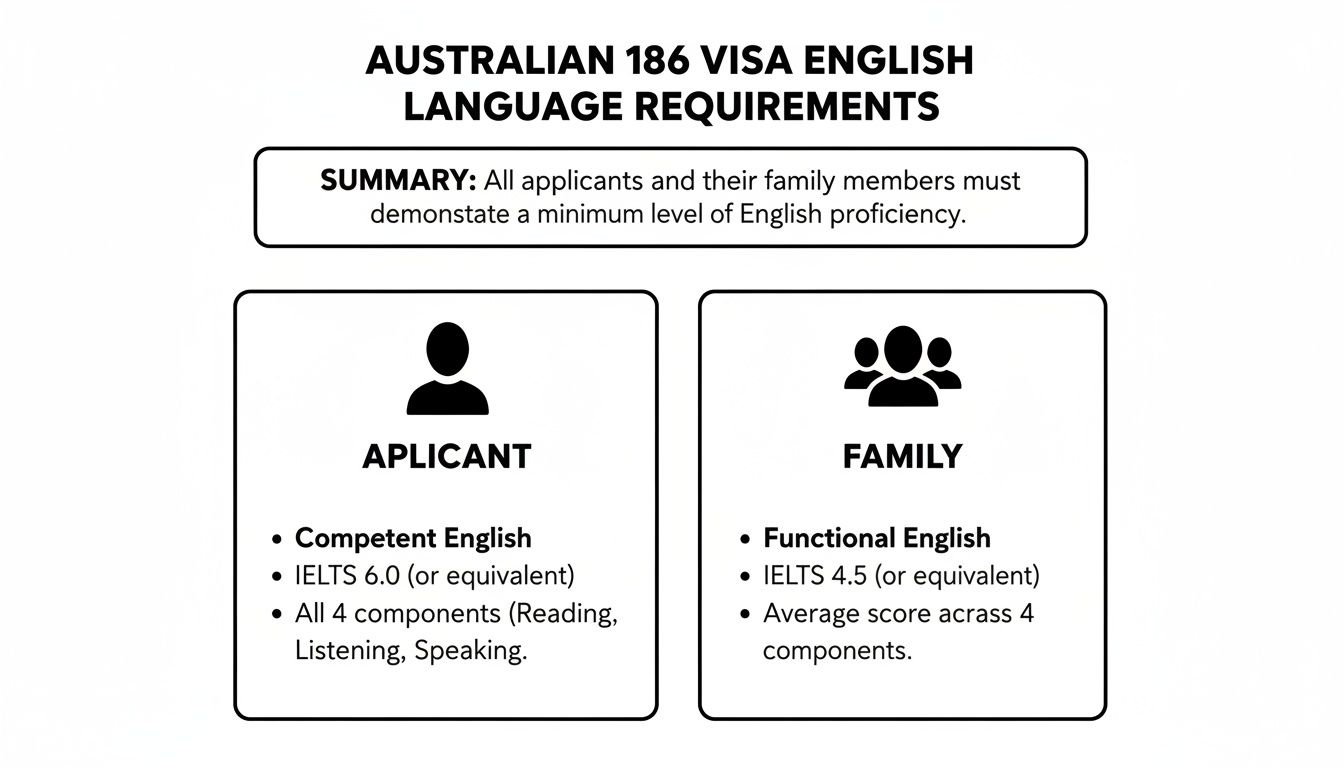
As you can see, the bar is set higher for you as the main applicant. Your 'Competent' English level is a step above the 'Functional' English needed for your dependents.
It's All About the Minimum Scores
Here's something crucial to understand: hitting the 'Competent English' mark isn't about your average or overall score. You must achieve the minimum required score in every single part of the test—listening, reading, writing, and speaking. You can't rely on a high score in one section to make up for a lower one elsewhere.
Whether you're applying through the Direct Entry, Transition, or Labour Agreement stream, the requirement is the same. The test must have been taken within the last three years before you lodge your visa application.
So, what scores do you actually need to aim for?
Accepted English Tests and Minimum Scores for Competent English
This table breaks down exactly what you need to score in each component for the five accepted English tests. There's no ambiguity here—these are the numbers you have to hit.
| Test Name | Listening | Reading | Writing | Speaking |
|---|---|---|---|---|
| IELTS | 6.0 | 6.0 | 6.0 | 6.0 |
| PTE Academic | 50 | 50 | 50 | 50 |
| TOEFL iBT | 12 | 13 | 21 | 18 |
| OET | B | B | B | B |
| Cambridge (C1 Advanced) | 169 | 169 | 169 | 169 |
This clear breakdown helps you set a concrete goal for your test preparation, no matter which test you choose.
Crucial Reminder: Your test results must be valid when you submit your visa application. For Australian migration, English test scores are generally valid for three years from the test date.
Timing is absolutely everything. An expired test certificate is a non-starter and will likely lead to a visa refusal. Make sure you book your test with enough time to get the results and apply well before they expire.
Getting your test strategy right is a massive part of the visa journey. If you need some help navigating the preparation and booking process, have a look at our dedicated English proficiency support services.
Proving Functional English for Family Members
The English proficiency requirement for the Subclass 186 visa isn't just for you, the primary applicant. It also extends to any family members coming with you, like a spouse or de facto partner, who are 18 years of age or older. This is all about ensuring everyone in the family can find their feet and participate in Australian life.
But here’s the good news: the bar is set differently for them. Instead of 'Competent English', your adult family members only need to demonstrate 'Functional English'. It’s a more basic level of proficiency, but proving it is still a critical step for a successful visa outcome.

The Two Pathways for Family Members
Think of meeting the Functional English requirement as a fork in the road. Your family has two clear options, and the one you choose has some pretty big financial and practical implications for your application.
- Prove Proficiency Through a Test: The most common path is to provide evidence of English skills by sitting an approved test.
- Pay the Second Visa Application Charge (VAC): If a family member can't (or decides not to) prove their English level, you have the option to pay a hefty government fee instead.
Getting your head around these two options early on helps you build a solid strategy, manage your budget, and gather all the right documents without any last-minute panic.
What Does Functional English Look Like in a Test?
If you go down the testing route, you’ll find the required scores are much more achievable than those for the main applicant. The focus is on an overall or average score, not a minimum score in each component. For instance, a family member just needs to get an overall band score of at least 4.5 on the IELTS test.
Disclaimer: Immigration laws and visa requirements can change. The information in this article is for general guidance and may not be current when you read it. For the most up-to-date and personalised advice, we strongly recommend booking an appointment with a registered migration agent. For current visa application charges, please always refer to the official Department of Home Affairs website: https://www.homeaffairs.gov.au/.
And it's not just about tests. There are other ways to show Functional English, like holding a passport from certain English-speaking countries or having completed specific levels of education where English was the language of instruction.
The Financial Decision: The Second VAC
The second pathway is purely a financial one. If an adult dependant can’t meet the Functional English standard, you’ll have to pay the second instalment of the Visa Application Charge (VAC) before the visa can be granted. This is a significant extra cost on top of all the other visa fees.
Secondary applicants need to prove Functional English by the time a decision is made on the visa, usually with a test like IELTS 4.5 taken within the previous 12 months. If that doesn't happen, a second VAC of $4,890 kicks in—a fee clearly designed to encourage people to hit the books. Data shows that around 15% of families successfully use tests to sidestep this extra charge, saving a chunk of money on their way to permanent residency. You can find more insights on visa details like these at Visatasker.com.
This turns your family’s English requirement into a crucial financial decision. You have to weigh the cost and effort of preparing for a test against a very large, non-refundable government fee.
Who Can Skip the English Test?
This is one of the biggest questions we get from Subclass 186 visa applicants: "Do I really need to sit an English test?" While many people hope their university degree or years working in Australia will get them off the hook, the reality is the rules for exemptions are very narrow and very strict.
It’s crucial to know exactly where you stand, because assuming you’re exempt when you’re not can bring your whole application to a grinding halt.
For the main visa applicant, the path to an exemption is quite simple. You can skip the formal English test if you hold a current passport from one of these five countries:
- The United Kingdom
- The United States of America
- Canada
- New Zealand
- The Republic of Ireland
If you're a citizen of one of these countries, your passport is all the proof of English proficiency you need for the 186 visa. Simple as that.
Let's Bust Some Common Exemption Myths
Now, this is where a lot of people get tripped up. There are a couple of widespread beliefs about the 186 visa English requirements that are just plain wrong. For the primary applicant, these assumptions can be a costly mistake.
Disclaimer: Immigration laws and visa requirements can change. The information in this article is for general guidance and may not be current when you read it. For the most up-to-date and personalised advice, we strongly recommend booking an appointment with a registered migration agent. For current visa application charges, please always refer to the official Department of Home Affairs website: https://www.homeaffairs.gov.au/.
Let’s clear the air on the two most common myths we hear all the time:
- "But I studied at an English-speaking university!" It doesn't matter. Even if you have a PhD from Harvard, if you aren't holding one of the five passports listed above, you still have to sit an approved test to prove 'Competent English'. Your degree is not a substitute.
- "I've worked in Australia for years!" Again, this doesn't get you an exemption. Your practical, everyday use of English in the workplace, even for a decade, won’t replace the need for a formal test score.
The Department is incredibly black-and-white on these points. Don't risk your application by assuming otherwise.
Are There Any Other Exceptions?
While the passport rule is the main game, there are some very rare and specific exceptions that can pop up under certain Labour Agreements. A Labour Agreement is a special deal negotiated between an employer and the Australian government, usually to fill unique skill gaps.
Occasionally, these agreements might have slightly different English language requirements written into them. But this is definitely not the standard way of doing things.
Think of Labour Agreement exemptions as the rare exception, not the rule. Unless you know for a fact you're being sponsored under one of these unique agreements, you absolutely should be planning to meet the standard English test requirements.
For the vast majority of applicants, the path forward is crystal clear: either you hold a passport from one of the five specific countries, or you need to book, take, and pass an approved English language test. Knowing this from the get-go saves you time, stress, and allows you to focus your energy on what really matters—nailing the requirements.
Your Action Plan for Meeting the English Requirement
Knowing the rules is one thing, but having a clear plan is what turns that knowledge into a successful visa application. Let's break down the whole process—from picking a test to lodging your results—into simple, manageable steps. Think of this as your roadmap to confidently ticking the 186 visa English requirements box.
The first big decision is which test to take. While all five approved tests get you to the same place, they're not all the same. You need to think about your own strengths. Are you more comfortable with a computer-based test like the PTE Academic, or does a classic paper-based exam like the IELTS feel like a better fit?
Take some time to look into the format of each. For instance, PTE is famous for its fast, computer-marked results, whereas the IELTS speaking test is a real, face-to-face chat with a human examiner. Choosing the test that plays to your strengths can genuinely make a difference to your final score.
Step 1: Choose and Book Your English Test
Once you've zeroed in on the right test for you, the next job is to book your exam date. Whatever you do, don't leave this until the last minute. Test centres, especially in popular cities, can get booked out weeks or even months in advance.
Here’s a quick checklist to get it right:
- Find an Official Centre: Make sure you only book at a centre that's officially accredited by the test provider (like IDP or British Council for IELTS, or a Pearson Professional Center for PTE).
- Book Well Ahead: Give yourself a buffer. I always recommend booking your test at least one to two months before you plan to lodge your visa. This gives you time to retake it if something goes wrong, without derailing your whole application timeline.
- Check Your ID: Your passport must be valid, and the name you use to book the test has to match your passport exactly. Even a small difference can cause massive headaches on test day.
Step 2: Build a Solid Preparation Strategy
Booking the test is just the first step; now you need a solid plan to get ready for it. Good preparation is what separates people who pass the first time from those who end up paying for costly and stressful re-sits.
Your best bet is to start with the official practice materials from your chosen test provider. These are the gold standard because they’re made by the same people who write the actual exam. They'll get you familiar with the question styles, the timing, and what the examiners are looking for. If you have a specific language background, you might also find targeted resources helpful, like a practical guide to English lessons for Spanish speakers.
Disclaimer: Immigration laws and visa requirements can change. The information in this article is for general guidance and may not be current when you read it. For the most up-to-date and personalised advice, we strongly recommend booking an appointment with a registered migration agent. For current visa application charges, please always refer to the official Department of Home Affairs website: https://www.homeaffairs.gov.au/.
The key is to be honest about your weak spots. If writing is your big challenge, start practising timed essays. If listening is tough, get some English-language podcasts or news shows into your daily routine. Consistent, focused practice is always going to beat last-minute cramming.
Step 3: Submit Your Results the Right Way
You’ve sat the test and your scores have come through—fantastic! The final piece of the puzzle is getting those results into your visa application correctly. This is a simple administrative task, but it’s one you absolutely have to get right.
When you lodge your visa application, you'll be asked for your Test Report Form (TRF) number or a similar registration ID. This is the unique code that lets the Department of Home Affairs check your results directly with the test provider.
Here’s exactly what you need to do:
- Find the TRF number on your official score report.
- Enter this number carefully into the right spot on your ImmiAccount application form.
- Upload a high-quality, full-colour scan of your entire test report certificate as one of your supporting documents.
Before you hit submit, check that number one last time. A simple typo in your TRF number can cause a verification failure, leading to completely avoidable delays in your application processing.
Common Mistakes That Can Delay Your Application
Getting your English language evidence right for the 186 visa is mostly a matter of ticking boxes, but a few simple slip-ups can cause some seriously frustrating delays. Think of it like a final quality check before launching a major project—catching a small error now saves you a massive headache later. This section is your pre-lodgement checklist to help you sidestep the common traps.
Even a minor mistake in proving your English proficiency can, unfortunately, hit the pause button on your whole permanent residency application. By seeing where others have stumbled, you can navigate this part with confidence and keep your visa process moving smoothly.

Submitting an Expired Test Result
This is, without a doubt, one of the most common and easily avoided mistakes we see. For the Subclass 186 visa, your English test results are only valid for three years from the day you actually sat the exam. Lodging an application with a test that's even a single day over this limit will mean it won't be accepted.
- How to Avoid It: Before you do anything else, grab your Test Report Form (TRF) and double-check the date. The smart move is to plan your test well inside that three-year window, giving you a comfortable buffer to get your application together without the stress of a looming expiry date.
Misunderstanding 'Per Component' Scores
So many applicants get fixated on their overall test score, but for the primary applicant’s 'Competent English' requirement, this is a huge mistake. You absolutely have to achieve the minimum required score in every single component: listening, reading, writing, and speaking. Scoring brilliantly in three sections just can't make up for a shortfall in the fourth.
- How to Avoid It: When you're studying, be honest about your weak spots and focus your energy there. Your goal isn't just a high average score; it's about hitting that minimum benchmark across all four skills.
Incorrectly Assuming an Exemption Applies
The rules around English test exemptions are black and white, with very little grey area. It's a critical error to think that your degree from a university in an English-speaking country, or your years of work experience in Australia, will automatically get you out of the test. Unless you hold a passport from the UK, USA, Canada, New Zealand, or Ireland, you must provide a test result.
- How to Avoid It: Never, ever assume. Go back to the official criteria and read them carefully. For the vast majority of 186 visa applicants, sitting the English test is simply a non-negotiable step.
Disclaimer: Immigration laws and visa requirements can change. The information in this article is for general guidance and may not be current when you read it. For the most up-to-date and personalised advice, we strongly recommend booking an appointment with a registered migration agent. For current visa application charges, please always refer to the official Department of Home Affairs website: https://www.homeaffairs.gov.au/.
Forgetting About Secondary Applicants
Here's an oversight that can be very costly. It’s easy to forget about the 'Functional English' requirement for partners or dependants over the age of 18. If they can't show evidence of their English level, you’ll be hit with the second Visa Application Charge (VAC)—a hefty and often completely unexpected expense.
- How to Avoid It: Have this conversation with your family members early in the process. Decide together whether they will sit an English test or if you need to start budgeting for that second VAC payment. This ensures there are no nasty financial surprises down the line.
Frequently Asked Questions
When you get down to the nitty-gritty of the 186 visa English requirements, a few common "what if" scenarios always pop up. This is where we tackle those specific, real-world questions we hear from applicants all the time.
Think of this section as clearing up the final few points of confusion so you can lodge your application feeling confident and fully prepared. Let's dive into the details that often catch people out.
Is the English Requirement Different for Each Stream?
This is a straightforward one, and the answer is no. Whether you're applying through the Direct Entry (DE), Temporary Residence Transition (TRT), or Labour Agreement stream, the English benchmark is exactly the same for the main applicant. You must show you have ‘Competent English’, no matter which pathway you take.
The thinking behind this is pretty simple: the government wants to ensure all skilled workers have a consistent and practical level of English to slot into the Australian workplace and community.
What if My English Test Expires After I Apply?
Here's a crucial point that can cause a bit of stress: the date that truly matters is the day you lodge your visa application. As long as your English test results are valid (meaning less than three years old) on that specific day, you’ve met the requirement.
Even if your test certificate expires a week, a month, or a year later while your application is still being processed, you're in the clear. The Department of Home Affairs locks in the result from your lodgement date. This is why planning ahead is so important—try to lodge with at least a few months of validity left on your test just to be safe.
Disclaimer: Immigration laws and visa requirements can change. The information in this article is for general guidance and may not be current when you read it. For the most up-to-date and personalised advice, we strongly recommend booking an appointment with a registered migration agent. For current visa application charges, please always refer to the official Department of Home Affairs website: https://www.homeaffairs.gov.au/.
Do My Children Under 18 Need to Take an English Test?
Good news for families—no, children under the age of 18 are not required to sit an English test for the Subclass 186 visa.
The requirement to demonstrate 'Functional English' (or pay the second Visa Application Charge) only kicks in for your spouse or de facto partner, and any dependent children who are 18 years or older when you apply. This rule definitely simplifies the process for those with younger kids. If you're looking at the bigger picture of bringing your family to Australia, it might be helpful to read up on the different Australian permanent residency pathways.
Can I Combine Scores from Two Different Tests?
This is a firm no. You cannot mix and match scores from different test sittings or different types of tests. You must hit the 'Competent English' benchmark in a single, complete attempt of one of the approved English exams.
So, for example, you can't take a high reading score from an IELTS test and combine it with a strong writing score from a PTE exam. The Department needs to see that you met the minimum score across all four components—listening, reading, writing, and speaking—on the very same Test Report Form.
At My Visa Guide, we specialise in turning complex immigration rules into clear, actionable strategies. If you're feeling uncertain about any aspect of your 186 visa application, from English requirements to document preparation, our MARA-certified agents are here to provide the expert guidance you need for a smooth and successful journey. https://www.myvisaguide.com.au